
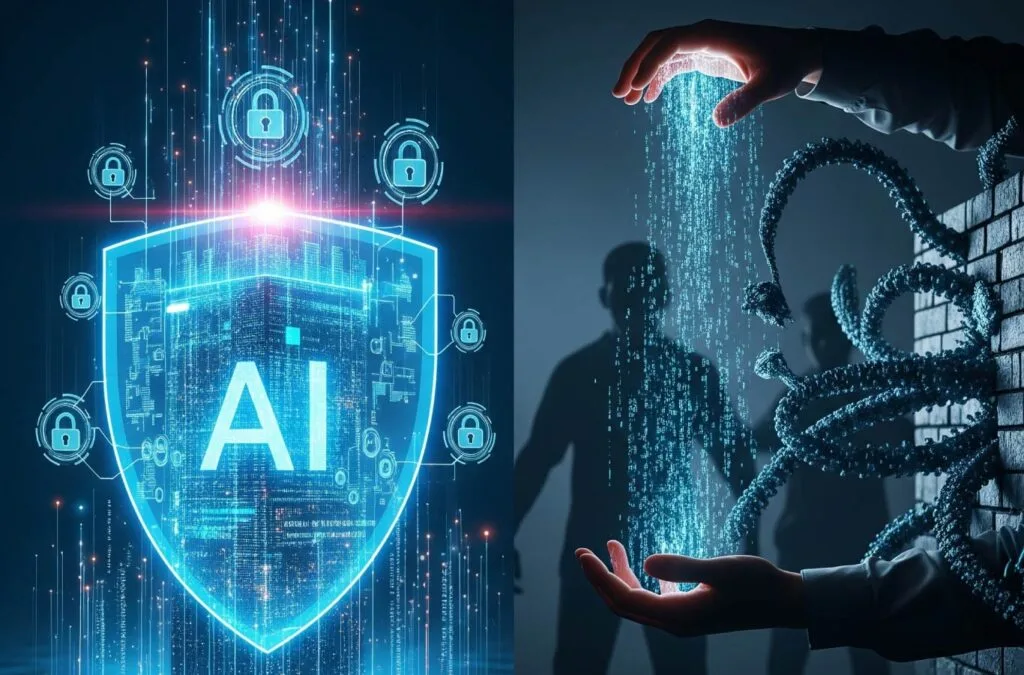
How artificial intelligence is fueling both sides of cybersecurity
Artificial intelligence (AI) is rapidly transforming cybersecurity, not only as a defensive tool but also as a weapon in the hands of cybercriminals. As AI battles AI, the risks to digital security have never been higher.
It's a familiar scene that plays out every day in companies: an employee receives an email that appears to be from a trusted colleague and follows the instructions without a second thought. Perhaps they click a link, download a file, or reply quickly—all routine tasks—until, unwittingly, they open the door to a cyberattack.
With 95% of cybersecurity breaches caused by human error and the average cost of a breach now exceeding $4 million USD , it's a simple and common mistake, but with major consequences.
And it's not just small businesses that are feeling the pressure.
Just this month, cyberattacks brought down the systems of three major UK retailers within days of each other, a stark reminder that organizations of all sizes need to be prepared.
For retail giant M&S, the attack halted all online orders through its app and website, wiping out £1 billion in value . Forecasts suggest it could be months before things return to normal.
Days after the attack on M&S, an ongoing cyber incident at Co-op forced the British retailer to shut down some of its computer systems to contain the attack. A day later, the luxury department store Harrods was forced to restrict internet access on its premises following an attempt to access its systems.
But for many, the threat is not an isolated incident: it is relentless.
Amazon.com defends itself against more than 1.000 billion cyberattacks every day , which is equivalent to more than 11.500 every second.
“The speed and simplicity of accessing large language models and AI is unleashing an unprecedented era of cyber threats, and cybercriminals are only getting smarter,” says Vladimir Vasilev, digital leader at Baker Tilly (Dominican Republic).
But the good news? Defenses are getting smarter too.
“From intelligent threat detection to adaptive email filters, today’s most effective cybersecurity tools are powered by AI that learns, evolves, and responds in real time,” says Mr. Vasilev.
“The future of security is not human versus AI, it’s AI versus AI.”
Bad boy
Online scams used to be clumsy and easy to spot, but generative AI has changed that, warns Mr. Vasilev.
“AI has amplified social engineering. We’re talking about emails that perfectly mimic someone you trust, systems that scan for vulnerabilities, and deepfakes that can convincingly manipulate both sight and sound. These aren’t just theoretical threats: they’re dramatically making it easier to trick people into handing over sensitive data or access.”
According to Mr. Vasilev, platforms like ChatGPT have transformed the landscape with their ability to generate fluid, human-like text at high speed. “In the wrong hands, that means more believable scams, more viral fake news, and even voice clones that can fool even the most discerning eye or ear.”
Looking ahead, he warns that the real tipping point could be autonomous AI. “Once machines start making decisions independently, the risks increase significantly. These include acting without human oversight, being vulnerable to malicious attacks, making biased or flawed decisions, creating uncertainty around liability when mistakes occur, and exposing personal data to greater risk.”
AI is a double-edged sword: the same tools that empower cybercriminals are also being used to defend against them. “It’s not simply about the technology itself: it’s about how, and by whom, it’s used.”
Good guy
Organizations that widely use AI and automation in cybersecurity save an average of US$2,22 million compared to those that don't. So it's no surprise that more than two-thirds of businesses now rely on technology to detect and stop cyberattacks.
“AI simply surpasses humans when it comes to handling and analyzing massive volumes of data,” explains Mr. Vasilev. “And that’s exactly what’s needed to keep up with today’s cyber threats.”
These tools never sleep.
They scan for anomalies, analyze behavioral patterns, and respond in real time, often with minimal human intervention.
By learning how users typically behave, AI can quickly detect unusual activity, blocking accounts or alerting administrators before any real harm is done. Machine learning is driving smarter antivirus software, more accurate threat intelligence, and faster, more adaptive defenses.
“AI is rapidly becoming cybersecurity’s most powerful ally,” says Mr. Vasilev. “In the future, it could be able to predict threats, automatically patch vulnerabilities, and even develop new forms of defense we haven’t yet imagined.”
But because the same technology that strengthens defenses also empowers attackers, Mr. Vasilev cautions that organizations must evolve alongside it: training teams to detect AI-driven threats, securing their own AI systems, and using AI to defend against AI-driven attacks.
But there is a big challenge: talent.
“Only about 12% of cybersecurity professionals have formal training in AI or machine learning,” Mr. Vasilev points out.
“That’s a serious gap, because to succeed in cybersecurity today, you can’t just be a security expert: you also need to be a junior AI expert. You need to understand the different types of machine learning, know how AI tools work (and where they fail), and stay up-to-date on the growing risks and regulations surrounding generative AI. It’s no longer optional: it’s a basic requirement.”
And the pressure is mounting. Amid a global cybersecurity talent shortage, many small businesses are also struggling to afford advanced, AI-powered security tools. At the same time, an ever-evolving regulatory landscape demands continuous skills upgrades, putting additional strain on already limited resources.
“It’s like running on a treadmill that never stops accelerating,” says Mr. Vasilev. “Exhausting, but essential.”
A balancing act
For most companies, data is their crown jewel, and when using AI, protecting it must be a top priority, explains Mr. Vasilev. “That means setting clear boundaries: sensitive information should not be fed into AI tools, and employees need guidance on what is safe to share.”
“It’s crucial to raise awareness among your employees about the various methods cybercriminals use to access sensitive information. Equally important is understanding how models like ChatGPT work and how to interact with them responsibly to avoid problems like AI poisoning.”
AI is powerful: it can write, program, analyze, and automate, and it's helping to drive innovation in industries from education to healthcare and finance. But it's not infallible, says Mr. Vasilev.
“Think of him less as a genius and more as a brilliant assistant: incredibly helpful but requiring supervision.”
“Used wisely, it can unlock enormous potential, from helping us work faster and smarter to generating new ideas. Used carelessly, it can cause serious risks.”
“Ultimately, the more consciously we use AI, the better we can leverage its strengths while avoiding its weaknesses.”
The era of responsibility
With more than 170 data protection regulations proposed or enacted in the past two years, it is clear that the era of AI responsibility has begun, and the rules are getting stricter. “Regulatory bodies around the world are implementing new frameworks and standards to curb misuse and promote responsible AI,” says Mr. Vasilev.
The EU's AI Act — the first of its kind — came into force in August 2024 and will be fully implemented in 2026, focusing on high-risk systems with stricter requirements.
In the United States, the National Institute of Standards and Technology has developed a risk management framework to better manage the risks associated with AI for individuals and organizations.
“Currently, there is no general regulation governing how AI should be developed, but specific applications—particularly those that pose potential risks—are being increasingly examined,” Mr. Vasilev notes.
“Platforms like TikTok and Meta are already adapting by implementing tools to detect and label AI-generated content, helping users identify when something is not real.”
Calculated intelligence
As AI redefines both defense tools and attack tactics, awareness, accountability, and intelligent implementation are critical.
Organizations that invest in understanding and guiding the use of AI — in cybersecurity and beyond — will be better positioned to harness its potential while protecting themselves against its risks.
“The future of AI in business is not just about innovation; it’s about trust, vigilance, and finding the right balance,” says Mr. Vasilev.